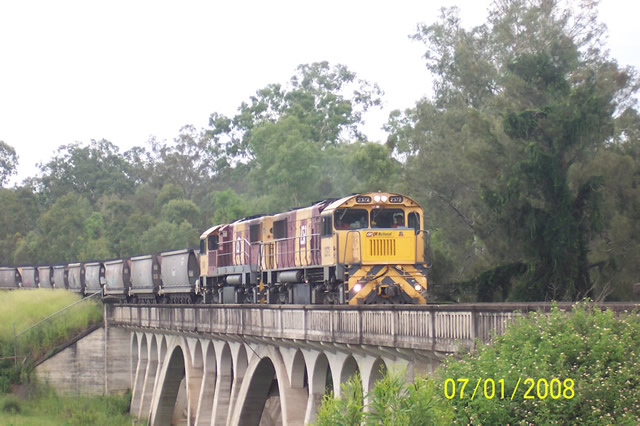
Concrete arch bridges are well suited for short and long spans where the foundations are solid, and may be constructed with either open or earth-filled spandrels. The Lockyer Creek bridge is what is known as a fixed multiple arch bridge, of the open spandrel type. Fixed is the term used, because the ends of each arch are integral with its foundations. Closed types of arches were typical for stone built bridges, such as the historic Risdon bridge in Tasmania. Arch bridge contrasts, include the hinged type, where stresses for unstable ground or situations can be transferred from one part of the structure to the other. A bowstring bridge, such as used in Grey Street Brisbane (William Jolly Bridge) allows part or all of the bridge deck to be suspended from the arch of the bridge
While the method of cast in-situ reinforced concrete was very innovative for its time, it was not the first in Australia. (The first bridge of any size using this method was built in France in 1899). The Queensland Railways had already completed a single arch concrete bridge near Gayndah in 1905. Another single arch bridge was completed over a dry gully off Lockyer Creek in 1910, to a similar design to the subject of this model. Concrete arch bridges of this type were also used in South Australia.
This three arch concrete bridge was completed in 1911, and has seen continued use for railway traffic to the present day. It replaced a timber trestle, with two central iron truss girders, which was on the eastern side of the new bridge. The new bridge had a solid concrete deck, on which was laid ballasted track to 3’ 6” gauge. All the construction, from the considerable foundations through to the deck, incorporated steel bars varying from 1/2” to 1/1/4” (12-32mm) diameter. Each bar of whatever length, had a “shepherds” crook bend at each end – this enabled the bars to anchor in the concrete. In this type of construction, it is the steel that has the load bearing capacity. The concrete simply acts as a placement skin.
The foundations of the two main piers, were dug 60 feet below deck level to bed rock, and the normal water surface of Lockyer Creek was 42 feet below deck level. The three arches are of an elliptical form, the pressure of a load being transmitted to 4 large concrete piers or masses, buried in sandstone and bedrock. Like an iceberg, much of a bridge mass is out of sight below ground level. The site was well chosen, and allowed the engineer to use a bridge design suited to a geology where there was no likelihood of foundation movement. This type of design is known as a fixed arch, because the ends of each arch are immoveable in the foundation.
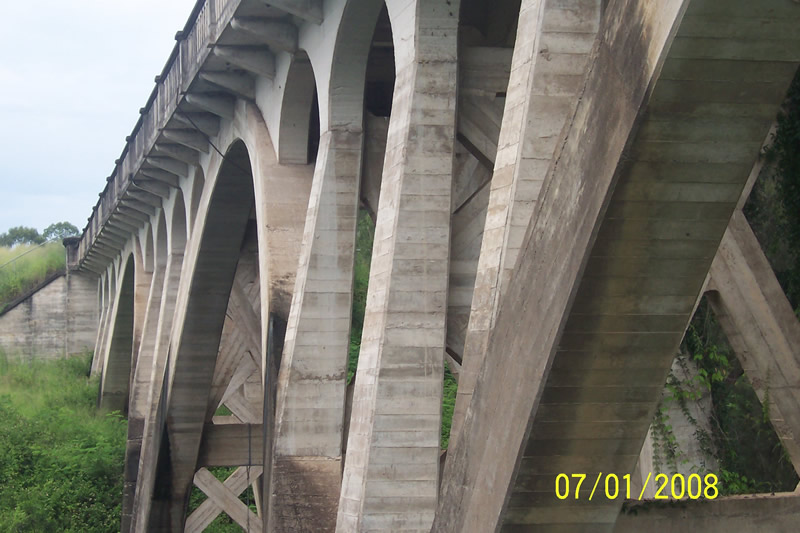
This photo was taken in 2008 looking north from under the southern main arch, showing the corbels under the deck, and the shapes of the other two arches.
William Pagan, whose signature appears on the engineering plans for this
bridge, was born at Holestain, Dumfriesshire, Scotland, in 1850 and died
at Southport, Qld, on 9 September 1924.
It is not known when he migrated to Australia but he was appointed a District
Engineer with the Queensland Railways on 21 January 1882. In 1889 he went
to Brisbane as Principal Assistant to the Chief Engineer and after holding
several senior positions was appointed Chief Engineer in 1902, becoming Deputy
Commissioner in 1911. In 1915, following a re-organization of the railway
administration, he was transferred to a separate division based on Townsville,
but still filling the position of Deputy Commissioner. Interestingly, the
surname Pagan appears in bridge building records from Fife, Scotland in the
nineteenth century.
Some facts:
Length overall 331 feet six inches (101.03 metres)
Deck width 13 feet (3.96 metres)
Main arch thickness at base 4 feet horizontally (1.22 metres)
3 main arches, and six supplementary arches as follows:
3x15 foot (4.6m) reinforced concrete arches, concrete abutment, common concrete
piers.
1x74 foot (22.6m) reinforced concrete arch supporting 2x12 foot (3.7m) and
1x13 foot (4.0m) reinforced concrete spandrel arches, common concrete piers.
1x90 foot (27.4m) reinforced concrete arch supporting 2x13 foot (4.0m) and
2x12 foot (3.7m) reinforced concrete spandrel arches, common concrete piers.
1x74 foot (22.6m) reinforced concrete arch supporting 1x13 foot (4.0m) and
2x12 foot (3.7m) reinforced concrete spandrel arches, common concrete piers.
3x15 foot (4.6m) reinforced concrete arches, common concrete piers, concrete
abutment.
Deck level to bedrock 60 feet (18.28 metres)
Deck level to 1893 flood level 27 feet (8.23 metres)
Deck level to sea level 700 feet (213.3 metres)
The bridge may now be fully visible from adjacent roads, due to the removal of much growth in the 2011 flooding. The bridge was hardly visible from adjacent roadways for many years, due to tree growth. When I was a boy (1950s) , it was pretty much all visible, and anyway, it is able to be accessed only from private property, or on the railway line itself.
Bibliography:
“ Spanning two centuries: historic bridges of Australia”, by Colin
O’Connor, University of Qld. Press, 1985 – I think you might find
this book is readily available at your local library.
Environmental
Protection Agency, Queensland Heritage Register.
http://www.heritage.gov.au/cgi-bin/ahpi/record.pl?QLD600515
Australia Post, commemorative set of 0.50c stamps featuring Landmark Australian
bridges, 2004, one of which is the Lockyer
Creek bridge.
http://www.auspost.com.au/download/bull_274.pdf
Information regarding the 2011 flood in Lockyer Creek
|
|
|